

Toast in 2026: what 5,000+ verified detections reveal
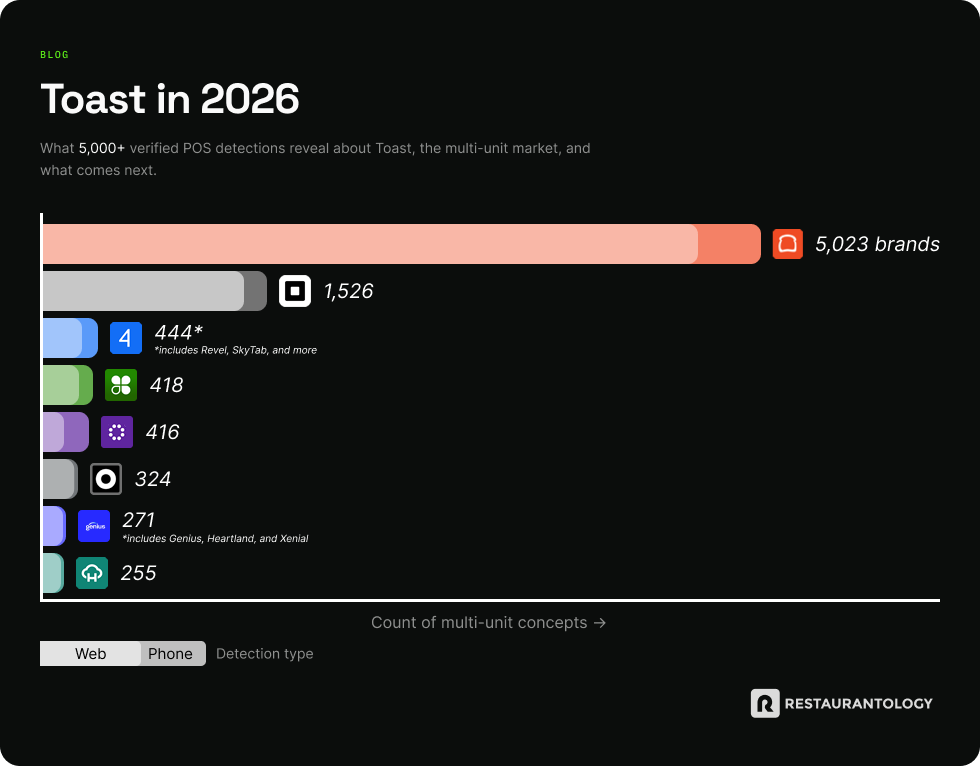
At the time this article was written, Restaurantology had confirmed 5,023 Toast detections across 16,500+ verified multi-unit restaurant profiles. That number moves daily as our team dials, reviews, and reconfirms. The analysis below reflects where things stand now.
Restaurantology just crossed 5,000 confirmed Toast detections.
That number represents 5,023 multi-unit restaurant brands running Toast POS. By brand count, Toast is the largest single POS detection in Restaurantology’s dataset.
By allocated unit count, the market looks more layered. Proprietary in-house systems, NCR Voyix, and Oracle Micros still account for more installs across multi-unit concepts. Those systems remain deeply embedded across large enterprise brands. Toast’s signal is different. Its footprint is especially visible across the growth layer of the restaurant market, where emerging and mid-market brands are still actively shaping their operating stack.
We have written about Toast twice before. In 2023, we mapped their early penetration of the multi-unit market. In 2024, we revisited the data and found the growth was not slowing.
Now the story has shifted again.
The count still matters. The signal underneath it matters more.
Toast’s footprint, in context
Toast reported 171,000 live locations globally as of Q1 2026, up 22% year over year. ARR crossed $2.2 billion.
Those numbers are real. They are also easy to misread alongside 5,023 detections because the two figures measure different things.
Toast reports locations across its full global platform, including independent operators, international markets, hotels, retail, and a broader hospitality footprint. Restaurantology tracks verified multi-unit restaurant brands in the U.S. and Canada, updated monthly at the account level.
Within that slice, roughly one in three verified profiles runs Toast. That figure only includes confirmed detections. Actual penetration across the full multi-unit market is likely higher, especially among 2-to-9 unit brands where POS usage is harder to detect from the web and may sit behind middleware, ordering platforms, or third-party digital infrastructure.
Web-only data misses real Toast accounts
Web detection at scale is harder than it sounds. Restaurant websites change constantly, ordering flows get rebuilt, and Toast signals can disappear overnight because of a site redesign or a new digital ordering provider. Every detection in this dataset is tied to a verified brand, a confirmed unit count, and a monthly refresh cycle. A 3-unit and a 300-unit brand may both run Toast, but they do not carry the same GTM value. AI can surface probabilistic clues. It cannot replace the work of verifying, reconciling, and maintaining that signal month after month.
Of the 5,023 confirmed Toast detections, 4,723 came from web detection. The remaining 300 came from phone verification of brands with 10 or more locations where Toast was not visible on the website at all.
For teams relying only on web-scraped data, those 300 Toast accounts effectively do not exist. Depending on average unit count, that gap may represent thousands of locations missing from prospect lists, territory models, and CRM segmentation before a rep ever makes a call.
“Not visible on the website” cannot be treated as “not using Toast.”
Toast brands grow, and that compounds
One pattern in our data that does not get enough attention: Toast over-indexes among high-growth and rapid-expansion brands.
Tomorrow’s mid-market and enterprise accounts often choose their operating systems years earlier, when they are still in the 10-to-30 unit range. The brands adding 20 or 30 locations a year today are often the same accounts enterprise AEs will be chasing three years from now.
Winning a Toast customer at 15 units can mean entering an account that becomes worth multiples of that within a typical contract cycle.
The signal is bigger than the count
Crossing 5,000 confirmed Toast detections is a useful milestone. The more important takeaway is what sits underneath the count.
Toast is especially relevant in the part of the market where many restaurant tech companies find their first traction: growing operators that are large enough to buy software, but still flexible enough to change systems, test new vendors, and expand quickly.
When one POS is this dense across the addressable market, it becomes one of the first filters that shapes which accounts a restaurant tech company can sell to, market to, partner around, or build for.
That is where the GTM implications begin.
Restaurantology tracks POS adoption across 16,500+ verified multi-unit restaurant profiles, updated monthly through web detection and phone verification. If you want to see where Toast, or any other POS, sits in your target accounts, the data is here.