

What AI-Powered Market Research Can Actually Support

How market coverage and the cost of being wrong determine the research your GTM motion requires
AI has made market research feel easier than ever before.
A GTM team can ask for a list of target accounts, estimate the size of a segment, check whether a restaurant brand uses a specific technology, or look for signs of growth in seconds. In many cases, the answer will be useful. In some, it may be exactly right.
The harder question is what that AI-generated answer is qualified to support.
A handful of examples can be enough to inspire a campaign. A verified fact about one account can help prepare for a sales call. A directional estimate can sharpen a hypothesis. But turning market intelligence into an operational GTM motion requires something more durable than a plausible response. Segmentation, prioritization, territory design, and trigger-based plays all depend on a trusted data foundation upstream.
These may begin as similar research requests, but they support very different levels of GTM execution.
That distinction matters because AI compresses the visible effort between asking a question and receiving an answer. The research feels complete because the response arrives quickly, confidently, and in a usable format. Less visible is how much of the market was actually covered, what was missed, how the answer was verified, and what happens when the same question needs to be answered again next month.
This is largely a positive development. AI is forcing GTM teams to think more critically about data acquisition, verification, and ownership. Those conversations were overdue.
The problem comes when a quick list of examples, a verified fact about one account, a directional market estimate, and a maintained view of the market are treated as versions of the same thing.
They may all begin with a prompt. They do not carry the same burden of proof, and they should not support the same decisions.
It has never been easier to get an answer. Knowing a market still requires something more.
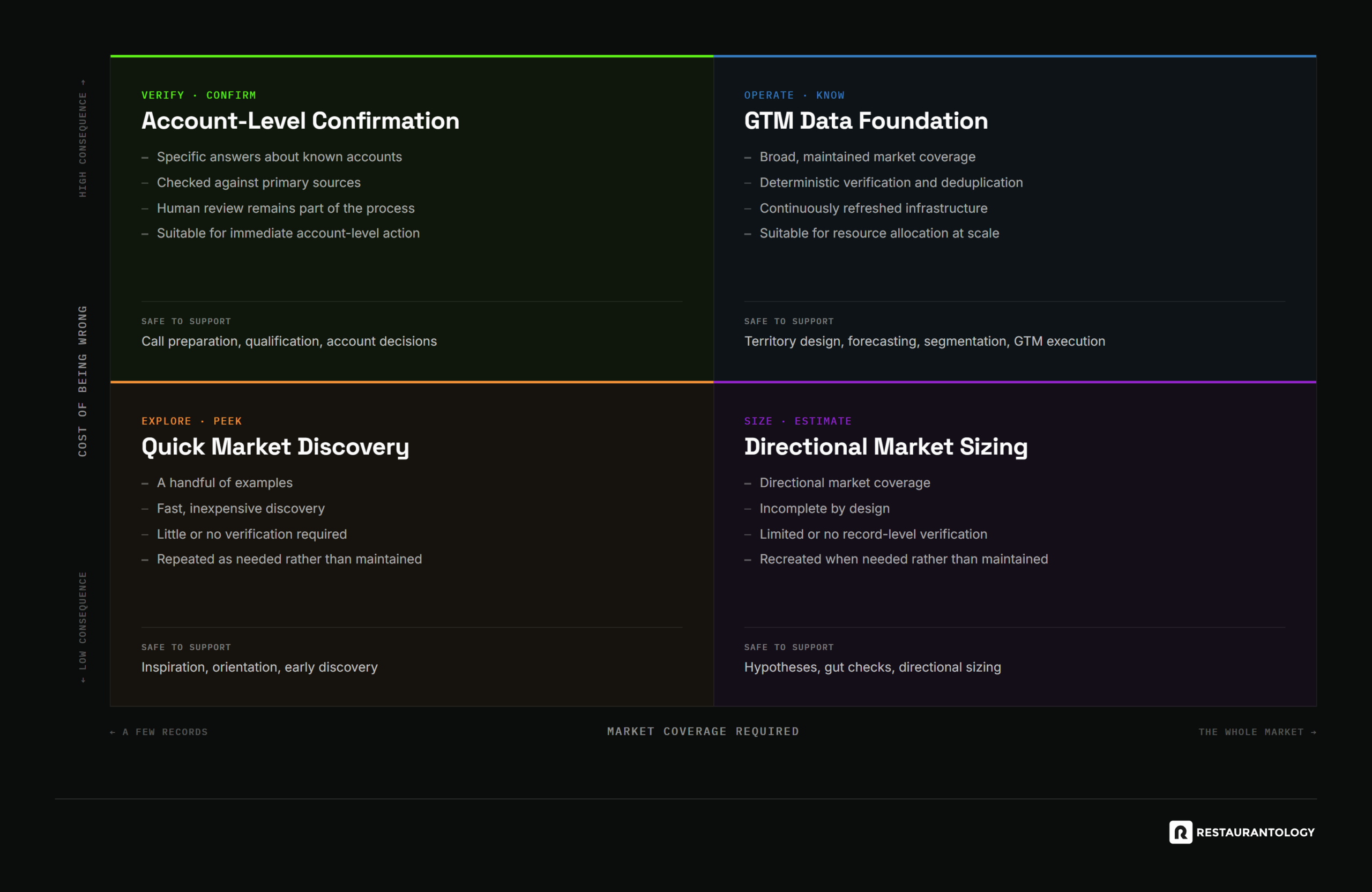
The Market Knowledge Landscape
Most debates about whether AI works for market research begin too broadly.
The better place to start is with two variables: how much of the market the research needs to cover, and how costly a wrong answer would be.
A request involving a few accounts creates a very different research burden than one involving the entire addressable market. The same is true of an answer used for early exploration versus one expected to support an operational decision.
Plot those variables against each other and four distinct research modes emerge:
- PEEK explores a few examples with a low cost of error.
- CONFIRM verifies a few facts where accuracy matters.
- SIZE explores a broader market without requiring full coverage.
- KNOW maintains broad, verified market intelligence for repeated use.
Each mode has a legitimate role. Problems begin when the output from one is treated as if it came from another.
A list generated for exploration gets presented as market coverage. A directional estimate becomes a territory model. A verified fact about one account gets extrapolated across an entire segment. The answer may still look polished, but the burden placed on it has changed.
The Market Knowledge Landscape provides a simpler way to evaluate the output: identify the coverage required, understand the consequence of error, and match the research method to the decision it needs to support.
[01] PEEK: Quick market discovery
PEEK is the simplest research mode: you need a small number of examples, and the consequences of missing one or getting one wrong are low.
This is where AI is at its best.
You might ask for restaurant brands experimenting with subscriptions, examples of loyalty programs built around paid membership, or a few concepts using a particular technology. The goal isn’t to map the market, it’s to get oriented, find inspiration, or identify where to look next.
Because the output is exploratory, completeness carries very little value. Ten useful examples may accomplish the job just as well as twenty. Verification may be unnecessary when no meaningful decision depends on every record being correct.
The infrastructure requirement is equally light. There is nothing to build, maintain, or refresh. You ask the question, use the response, and return later when you need another perspective.
That combination makes PEEK unusually well suited to conversational AI. The model can compress an open-ended search into something immediately useful without pretending to create a durable source of market truth.
The important part is preserving that boundary.
A PEEK answer can inspire a campaign or surface a new hypothesis. It becomes less reliable when the same list is treated as representative market coverage simply because it looks polished and complete.
[02] CONFIRM: Account-level research
CONFIRM begins with a narrower question and a higher burden of proof.
You are usually researching a known account, brand, technology, or market signal. The goal may be to prepare for a sales call, qualify an opportunity, validate an assumption, or support a specific recommendation.
AI can still reduce the work substantially. It can locate likely sources, summarize what it finds, and help narrow the search. But the answer only becomes actionable once it has been checked.
That is because one wrong answer about one account is not a rounding error. It can change how a rep approaches the conversation, whether an account enters a sequence, or how a recommendation gets framed internally.
The cost of CONFIRM therefore sits less in tokens and more in oversight. Someone still has to verify the claim against a source the business is willing to trust.
This is also where fluency creates the most risk. A wrong answer can sound just as complete and confident as a correct one, especially when the underlying source is unclear, stale, or inferred.
Used well, AI shortens the path to verification. Used carelessly, it replaces verification with confidence.
The distinction matters because CONFIRM is often the first point where market research moves from interesting to operational.
[03] SIZE: Directional market estimate
SIZE asks AI to move from a handful of examples toward a broader view of the market.
You might ask how many restaurant brands fit a certain profile, which concepts appear to use a particular technology, or what share of a segment seems to meet a specific criterion. The output can be useful for forming a hypothesis, pressure-testing an assumption, or getting a directional sense of scale.
The difficulty is that broad research often looks more complete than it is.
A model can generate a convincing list, summarize patterns across what it found, and present the result in a format that feels finished. What it usually cannot prove is that the search was exhaustive.
That gap grows as the market expands. The whole country feels too broad, so the question narrows to a state. The state still feels too large, so it narrows to a metro. Eventually the scope becomes small enough for the answer to feel credible.
Each step makes the task more manageable. None guarantees that the result represents the larger market you originally wanted to understand.
The underlying system is optimized to return a useful answer within practical limits around search, context, tokens, and compute. It has no inherent requirement to keep working until every relevant entity has been found, resolved, and verified.
The model is designed to finish the answer. The market problem may require the system to keep working.
That makes SIZE appropriate for directional sizing, early scenario planning, and gut checks. It becomes risky when a plausible estimate is promoted into a board claim, territory model, or market coverage decision.
A polished answer can still be an incomplete market.
[04] KNOW: GTM data foundation
KNOW begins when the business needs broad market coverage it can use repeatedly, confidently, and at scale.
The objective shifts from answering one question to maintaining a reliable view of the market that can support segmentation, prioritization, territory design, whitespace analysis, and trigger-based GTM plays.
That requires more than a larger prompt.
The underlying system has to collect from defined sources, resolve entities, deduplicate records, verify key attributes, preserve history, and refresh the data as the market changes. It also has to do that consistently enough that teams can act without reopening the research process every time.
This is where market intelligence becomes a GTM data foundation.
The value comes from persistence. A one-time snapshot begins decaying as soon as it is created. A maintained foundation keeps the market usable across decisions, teams, and time.
AI can be part of that infrastructure. It can accelerate collection, classification, enrichment, and analysis. But broad, trusted market knowledge still depends on the systems around the model: the repository, the rules, the verification, and the maintenance.
SIZE can help estimate what the market may look like. KNOW gives the business a foundation it can operate from.
Market research answers a question. A GTM data foundation supports a system of decisions.
Match the research mode to the decision
The right research mode depends on what the business is trying to decide.
PEEK supports exploration. CONFIRM supports action on a specific account. SIZE supports directional estimates. KNOW supports repeated decisions across the market.
The mistake is assuming one mode is inherently better than another. Each is appropriate when the coverage, consequence, and intended use match.
The same company may move between all four.
A startup testing a new segment may only need PEEK. The same team may use CONFIRM before contacting a high-value account, SIZE to estimate whether a market is worth pursuing, and KNOW once it needs to build territories, prioritize thousands of accounts, or coordinate execution across teams.
Company size changes the threshold as well. A small team can often operate effectively from narrower research because fewer people and decisions depend on the output. As the GTM organization grows, the cost of inconsistency compounds. Different reps begin working from different assumptions, account selection becomes harder to govern, and one-off research stops scaling.
The useful question is whether the research is strong enough for the decision being placed on top of it.
Before acting, ask:
- How much of the market needs to be represented?
- What happens if the answer is incomplete or wrong?
Those answers determine whether you need to explore, verify, estimate, or operate from a maintained foundation.
Exploratory information becomes dangerous only when it is promoted into operational truth.
When market research becomes infrastructure
AI has changed the economics of getting an answer.
It can accelerate discovery, compress research time, and help GTM teams investigate questions that once required far more manual effort. That makes it valuable across all four modes.
The required foundation still changes as the decision changes.
PEEK may only need a useful starting point. CONFIRM needs verification. SIZE needs clear limits around what the sizing exercise can support. KNOW requires broad, maintained market intelligence that teams can use repeatedly without reopening the research process every time.
That progression matters because downstream GTM motions inherit the strengths and weaknesses of the data beneath them. Segmentation, prioritization, territory design, and trigger-based plays become harder to trust when the upstream view of the market is partial, stale, or inconsistent.
The goal is to recognize which mode the decision requires, then avoid asking the output to carry more weight than it was built to support.
Most research questions should never need KNOW.
Once a company does need KNOW, the work no longer ends when the answer arrives. Coverage, verification, history, adaptability, maintenance, and cost become ongoing operating requirements.
That is where market research becomes infrastructure.
In Part 2, we will examine what companies are actually committing to own when they decide to build that infrastructure themselves.